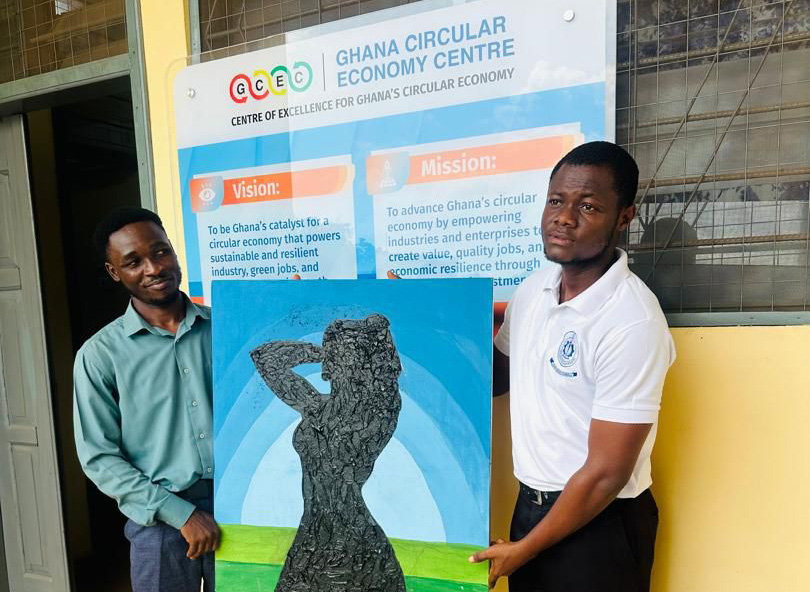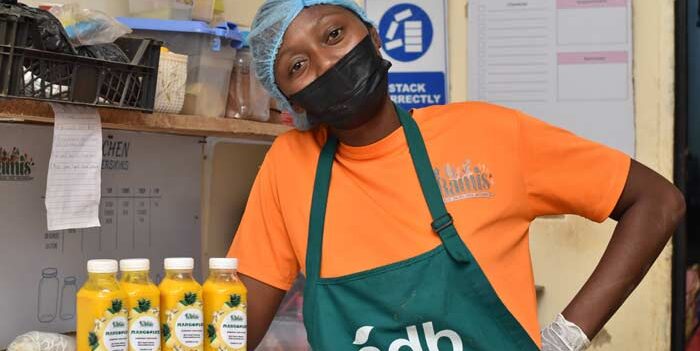


A lecturer at Ho Technical University used the GCEC training to move from teaching circular ideas to building a circular venture — with knock-on effects for her students, colleagues, and the traders she works with.
An Assistant Lecturer at Ho Technical University, a textile sustainability researcher, and a circular economy advocate, Bijou A. Asemsro had been teaching students to work with textile waste, plastics, and other discarded materials long before she ever engaged with the GCEC project. The ideas were already there. What she was missing was a practical pathway to turn that teaching into something workable, a real business model for her students and for herself.
Looking back, Bijou could name several things that had been holding her work back. The textile waste she had to work with was inconsistent in quality, which made every experiment unpredictable. Small trials were expensive. And while her students could design beautiful products, she noticed they often didn’t have the tools to turn a good circular idea into a business that could actually survive. She also didn’t yet have a clear way to teach lifecycle-based resource efficiency or the business side of circularity, the very things that decide whether a circular product can hold its own in a real market.
After the GCEC-supported training, Bijou saw a real shift in how she thought and in how she worked.
“I shifted from a researcher mindset to an entrepreneur mindset. GCEC did not just train me, it transformed how I see myself.”
Within two weeks after the training, Bijou had designed and run her own pilot. She introduced modular design principles into her workflow, sorting textile waste before cutting and reserving scraps for patchwork. She designed products that could be disassembled, repaired, and remade — building reuse and reparability directly into product design rather than treating them as afterthoughts. To test market demand, she ran a low-cost business model simulation through WhatsApp, with her students participating as both designers and prospective customers.
Bijou identified a set of new business opportunities arising from this pilot: modular and repairable bags and accessories, repair and take-back services, direct sales through WhatsApp, and training workshops for other circular entrepreneurs. While income gains are still emerging, she reported higher productivity, with modular design producing a faster and more repeatable production system. She has also begun compiling evidence to support future investor engagement through the GCEC mentorship network, and is preparing an article for publication.
Bijou’s experience is particularly significant because, by her own account, the change has extended well beyond her own practice. She reports that her students are now using modular design and WhatsApp-based validation in their own projects; that some trainees and used-clothing market actors have changed how they sort textile waste; and that a colleague plans to integrate modular design into her own course. If borne out by follow-up monitoring, these reported ripple effects suggest that the project’s influence is beginning to move through teaching practice, peer learning, and informal sector activity — reaching actors who are not always formally recognised as part of the circular economy, but whose everyday decisions shape how it functions on the ground.
Bijou’s experience reflects a recurring lesson in capacity-building work: participants who are both practitioners and multipliers can accelerate adoption across institutions and communities, particularly when training combines practical business-model tools with low-cost methods for testing ideas. In supporting Bijou, the GCEC project has reached not only one entrepreneur but, on her account, a wider circle of teachers, students, and informal sector actors who are beginning to carry circular practice forward.
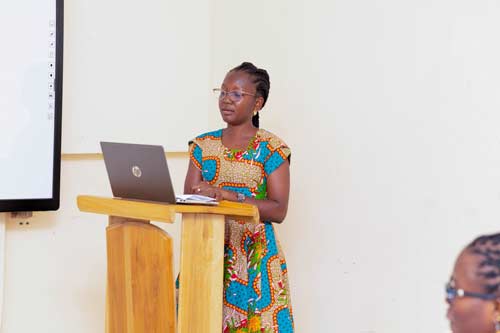
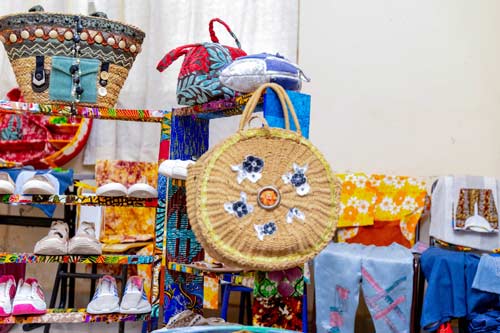
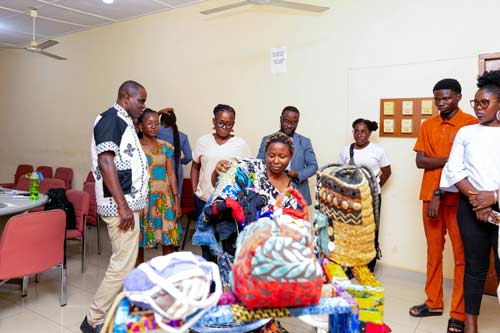
Photos of Bijou A. Asemsro (in the first image) with colleague lecturers and students at Ho Technical University, showcasing textile products developed using circular principles.