



What We Do
Our mission is to support the transition to a circular economy in Ghana through innovation, entrepreneurship, and sustainable development.
Strategic Pillars
GCEC advances the circular economy in Ghana by strengthening systems, enterprises, and ecosystems across priority value chains.
Our work focuses on:
Capacity Development
GCEC supports entrepreneurs, micro, small and medium-sized enterprises (MSMEs), informal sector actors, public institutions, and other ecosystem stakeholders through technical and entrepreneurial skills development, awareness-raising, and targeted training.
Technology & Innovation
The Centre promotes the development, adaptation, and deployment of circular technologies, products, and business models through technical assistance, pilot initiatives, and demonstration activities.
Access to
Finance
GCEC facilitates access to finance for circular economy solutions by strengthening investment readiness, linking enterprises to financial institutions and funding mechanisms, and working with partners to de-risk circular investments.
Policy & Market Development
GCEC generates evidence and analytical knowledge to inform policy dialogue and strengthen the enabling environment for the circular economy through research, opportunity mapping, value chain analysis, and market assessments.
Partnerships & Ecosystem Development
The Centre convenes public and private stakeholders including government institutions, industry, academia, development partners, and civil society to foster collaboration and knowledge exchange.
Circular Ventures Programme
The Circular Ventures Programme is GCEC’s flagship innovation and entrepreneurship programme. It supports the identification, development, and scaling of circular economy solutions led by innovators, startups, and micro, small and medium-sized enterprises (MSMEs).
What We Aim to Achieve
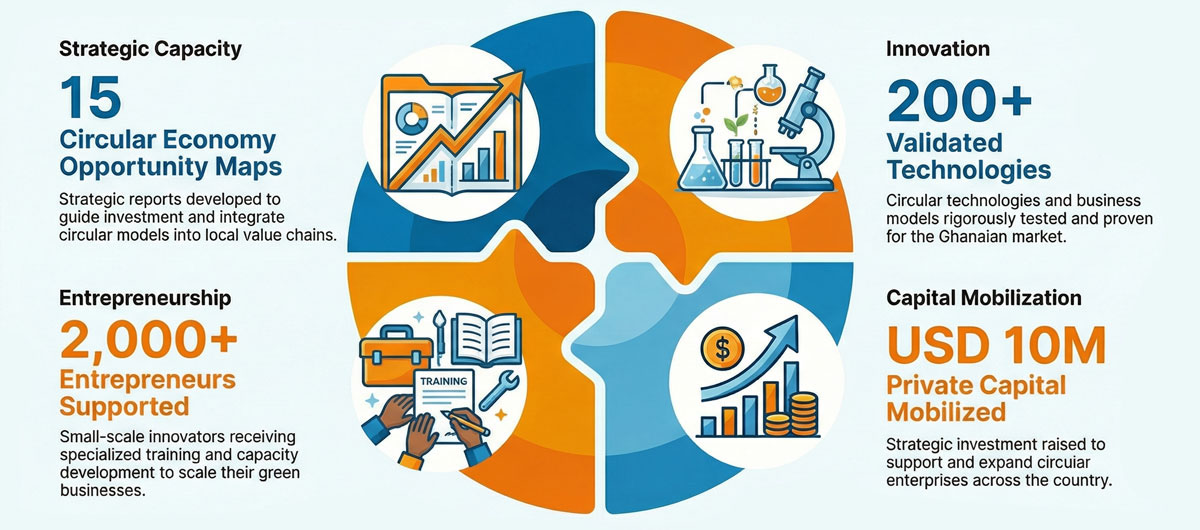
Through its programmes and partnerships, GCEC supports entrepreneurs, innovators, and institutions to translate circular ideas into practice. This includes developing opportunity maps to guide investment, building the capacity of thousands of small-scale entrepreneurs, validating circular technologies and business models, and mobilising private capital to scale circular solutions.
Priority Value Chains
GCEC focuses its interventions across key value chains where circular solutions can deliver high economic, social, and environmental impact:

Textiles
Ghana’s textiles sector, particularly the second-hand clothing trade, faces significant waste challenges linked to short product lifecycles and limited systems for repair, reuse and recovery. The Centre supports circular innovations that extend garment life, promote circular design and recover value from textiles that would otherwise be lost.
- Upcycling workshops & hubs
- Second-hand market optimization
- Sustainable fiber research

Agriculture & Agro-processing
Across Ghana’s agriculture and agro-processing value chains, significant economic and environmental value is lost through post-harvest decay, inefficient processing and underutilised by-products. In collaboration with sector stakeholders, the Centre advances circular innovations across the value chain, including regenerative production that restores soil and ecosystem health, resource-efficient processing, the valorisation of by-products into new goods, and the return of organic materials to the biological cycle. The result is a more resilient food system that creates rural livelihoods, builds the natural capital on which farming depends, and turns what was once waste into new sources of income.
- Regenerative farming techniques
- Bio-waste to energy conversion
- Value addition to agro-waste
Plastics
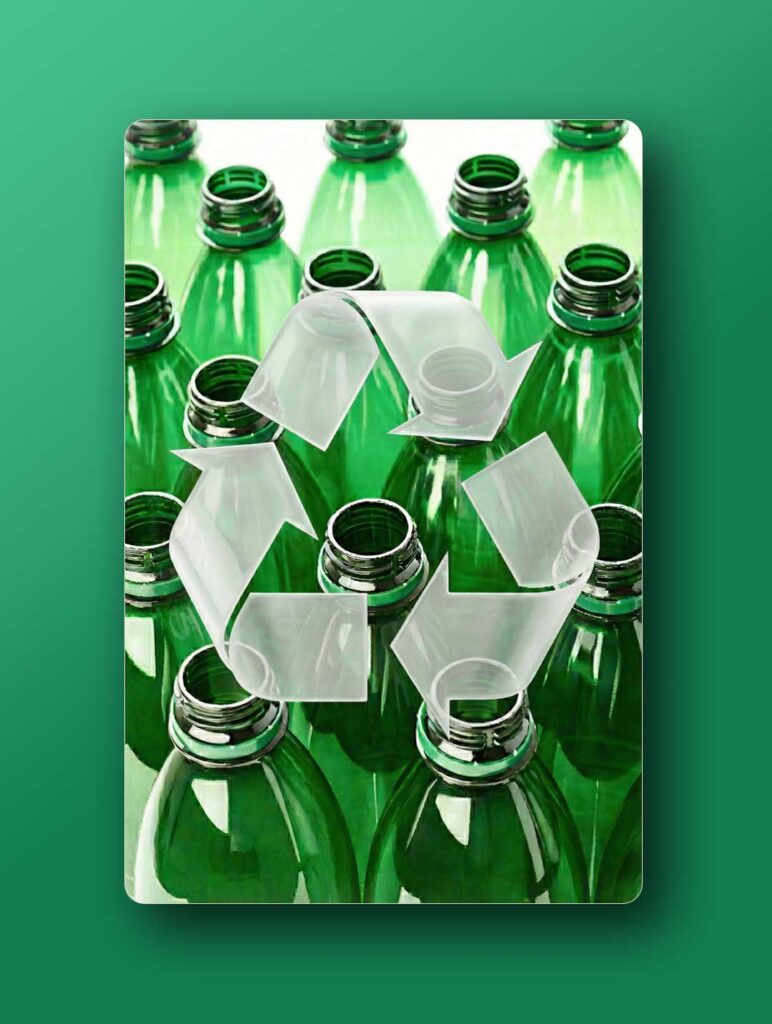
Plastics remain integral to Ghana’s economy, yet their largely linear flow continues to drive pollution, emissions and resource loss. The Centre works across the plastics value chain to advance circular innovations, including durable product design, reuse models, alternatives to single-use items, improved collection, sorting and recycling, and the reintegration of materials into production. This supports circular enterprises, green jobs and Ghana’s transition towards a plastics economy where materials remain in productive use rather than being lost as waste.
- Support for recycling startups
- Community collection drives
- Research into biodegradable alternatives
Ready to get involved?
Whether you are an innovator, an investor, or a policy maker, let’s collaborate to build a sustainable and waste-free future together.