

After a circular economy foundational training in Ho, an art student began turning plastic waste into raw material for his artworks — an early sign of how circular economy training can move from concept to practice.
Bernard Akwetey is a student and national service personnel in the Industrial Art Department at Ho Technical University. Until late last year, he produced his work mainly with acrylic paint. Although his practice already sat within the plastics and textiles space, he had not yet incorporated plastic waste into his production process in a deliberate or systematic way. That changed when he attended a foundational circular economy training delivered by the Ghana Circular Economy Centre (GCEC) in Ho.
The training reframed how he saw plastic waste. Where he had previously seen waste material to be discarded, he began to see a usable input — one that is locally abundant, freely available, and suitable for reuse in his work. In Ghana, where significant quantities of plastic are lost each year to open burning, with associated impacts on air quality and greenhouse gas emissions, the environmental case for reuse converged with a clear economic one for an artist who had been purchasing acrylics.
“I learnt that it is efficient to use waste plastics and that it contributes to keeping the environment clean and sustainable. That stayed with me.”
Bernard has since begun translating this learning into action, creating new pieces with waste plastic alongside his existing artistic methods. He notes that artworks made with plastic waste can be cheaper to produce than pieces relying only on acrylic materials — an early sign of the resource efficiency the training emphasised. He has also encountered practical design challenges, such as the need to use the right adhesives so that plastic does not come off easily. These are small technical questions, but they suggest he is now engaging with circular production as a real creative and technical process rather than only as an abstract idea.
Bernard’s experience reflects a pattern the project is observing across early training cohorts: practical training, when paired with locally relevant examples, can trigger experimentation almost immediately. Sustaining that momentum will require continued support in product development, market testing, and technical refinement, so that early adopters can translate first attempts into more stable livelihoods and, over time, viable circular enterprises
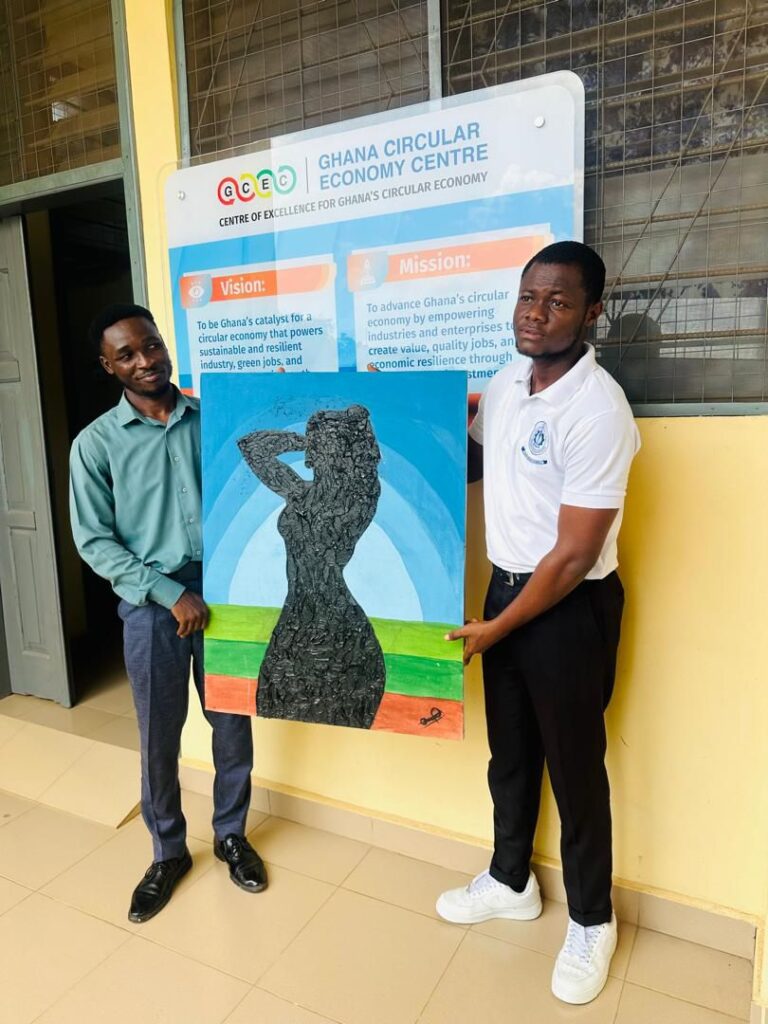

Photos of Bernard Akwetey (in a white T-shirt), a student at Ho Technical University, displays his artwork made from plastic waste.