

After a foundational circular economy training, a Ghanaian food entrepreneur is rethinking how her business handles waste, and looking inside her own by-products for a new revenue line.
For Leatrice Naa Kwarley Richardson, founder and director of Ramis Foods, a Ghanaian food production enterprise, waste used to be a problem with just one answer: get rid of it responsibly and keep its impact on the environment as small as possible. Her business had the systems in place to do exactly that. What it didn’t have was a different way of seeing waste, not as a cost to be managed but as something that could hold real value. That began to change earlier this year, when she joined a foundational circular economy training delivered through the Ghana Circular Economy Centre (GCEC) project in Accra. For the first time, she started to imagine what her by-products could become rather than simply how to dispose of them.
The training reframed how she saw her own production process. From the way raw materials are selected, through processing, to how leftover material is handled at the end, every stage became an opportunity for circular thinking. For a small business already wrestling with the cost of waste, the case for action was both environmental and commercial.
“The training gave us a second outlook to putting [waste] to use. It strengthened our resolve to move from just mitigating the effects of the waste to turning it into some form of revenue generation that was going to support us.”
Leatrice has since begun applying that thinking across the business. She reports that waste at Ramis Foods is down by what she calls “marginal percentages.” The figures are modest, but for a small enterprise they translate into real cost savings and a lighter environmental footprint. More striking is what she has spotted inside the by-products themselves: a fresh line of business in compost.
“For us, we found opportunity in converting waste to compost. It is an adventure that we are aggressively looking into exploring on a larger scale.”
Leatrice’s experience reflects a pattern the project is beginning to see among small-scale agro-processors who pass through the foundational training: knowledge gained does not stay theoretical. It moves quickly into operational decisions and, in some cases, into new revenue ideas inside the business itself. Her interest in scaling compost production, treating it as an output rather than a by-product, points to the kind of value-creation move the project is looking to seed across women-led agro-processing enterprises in Ghana.
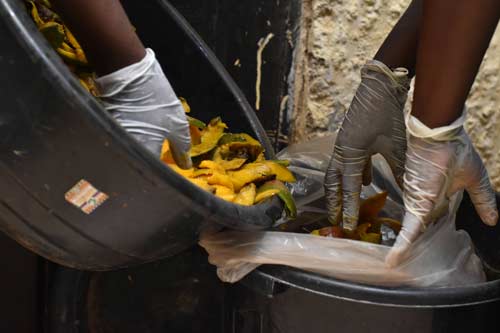
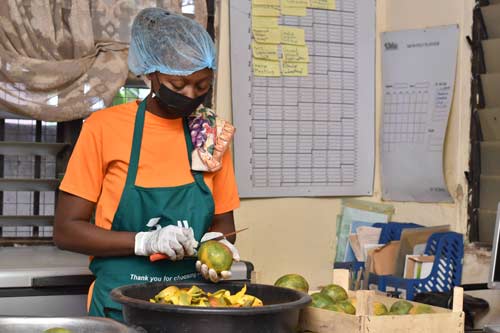
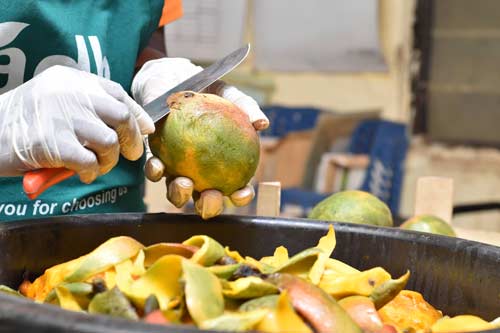
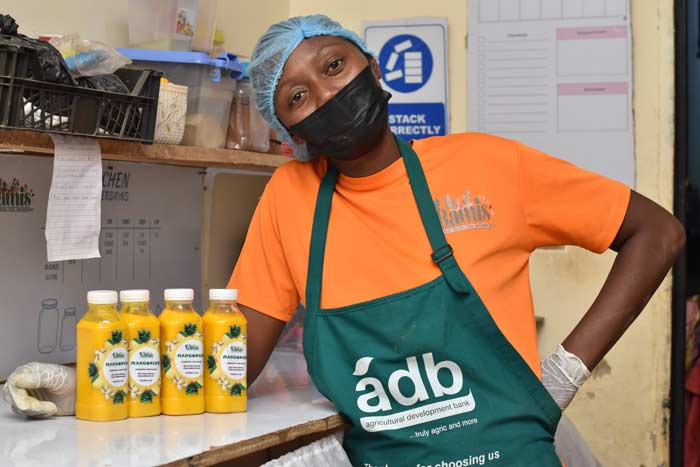
Photos of Leatrice Naa Kwarley Richardson at the Ramis Foods production site in Tamale, processing mango and the peels she is now exploring as feedstock for compost.