



Circular Ventures Programme
Turning circular economy opportunities into investable ventures.
Overview
The Circular Ventures Programme is the Ghana Circular Economy Centre’s pathway for turning circular economy ideas into pilot-ready and investment-ready businesses.
It supports innovators, entrepreneurs, students, informal sector actors and growth-oriented enterprises to respond to priority opportunities across Ghana’s key value chains, including plastics, textiles, agriculture and agro-processing, and other cross-cutting circular economy areas. Through hackathons, coaching, incubation and market-readiness support, participants move from problem identification to prototype, business validation and early-stage growth.
The programme places strong emphasis on inclusion, with dedicated support for women, youth and informal sector actors building environmentally responsible enterprises.
What the programme does?
The programme helps circular innovators develop solutions that reduce waste, retain value in the economy, improve resource efficiency and create inclusive green jobs. Participants are supported to identify real opportunities from roadmap evidence, shape venture concepts around priority hotspots, test value propositions and business models, strengthen pilot-level economics, and build readiness for investment, partnerships and scaling, while integrating environmental and social safeguards throughout.
It combines practical learning, business development support and peer collaboration so that ventures are not only innovative, but feasible, inclusive and grounded in Ghana’s economic and environmental context.
Programme pathways
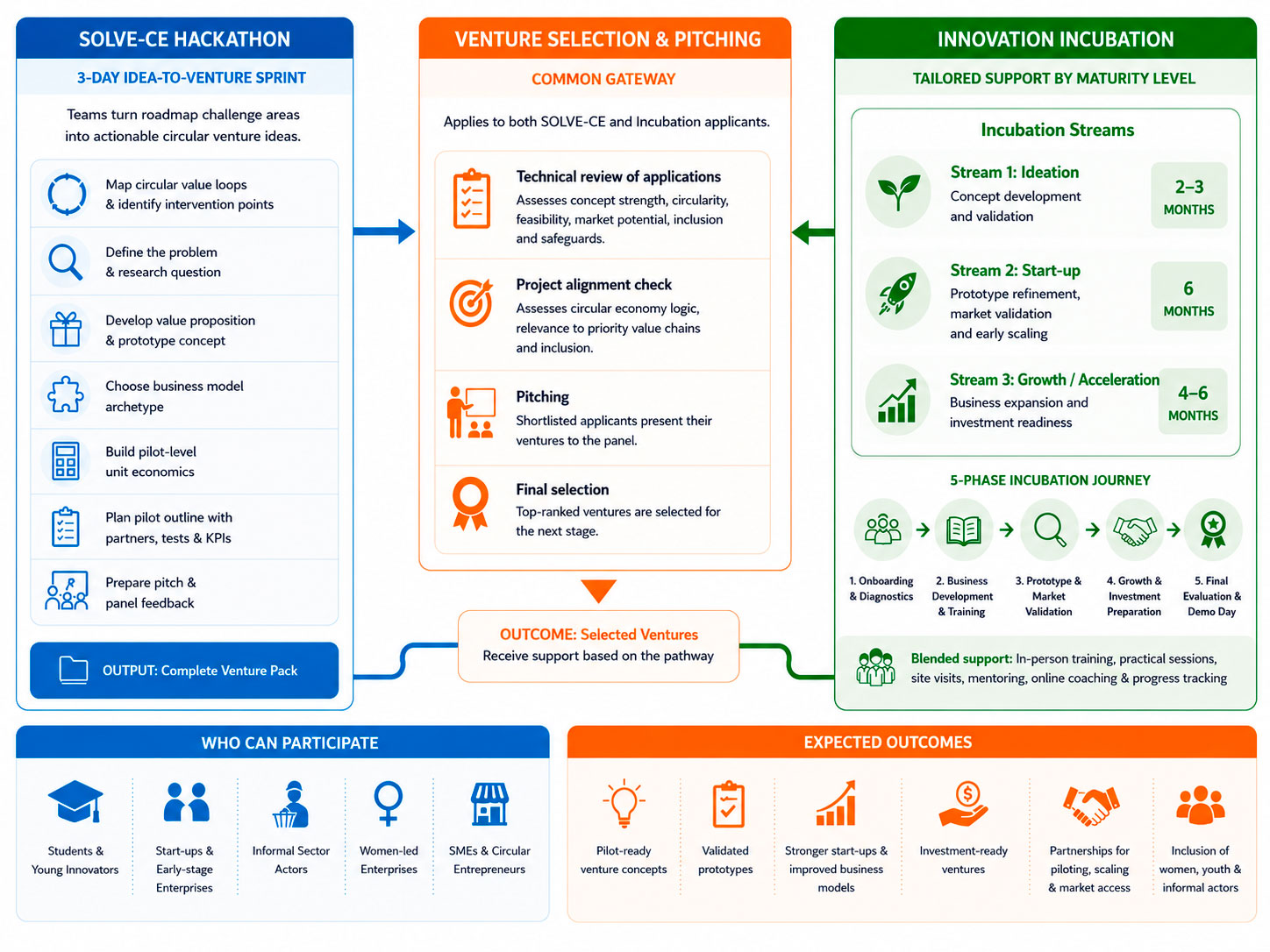
The programme offers two pathways for developing circular ventures: the SOLVE-CE Hackathons and the Innovation Incubation Programme. Each is an entry point in its own right, with the hackathons shaping new ideas into venture concepts, and incubation taking ventures towards growth and investment. A shared selection and pitching process applies across both, so that every venture that progresses meets the same standard of quality, circular logic and viability.
Pathway 1: SOLVE-CE Hackathons
An entry point for turning circular economy roadmap challenges into new venture ideas. Over a structured three-day process, teams analyse priority hotspots, define a clear problem, map circular value loops, develop a prototype concept and prepare a venture pitch, with each team focused on one product or service idea drawn from Ghana’s circular economy roadmaps.
Every team leaves with a complete venture pack:
- a circular value loop map;
- a clear problem statement and research question;
- a value proposition and prototype concept;
- a circular business model archetype;
- pilot-level unit economics;
- a pilot outline with partners, tests and KPIs;
- a pitch presentation and panel feedback.
The result is an evidence-based idea with a clear plan for what to test over the next three to six months.
Pathway 2: Innovation Incubation
An entry point for ventures ready to grow, and the structured engine through which selected ideas are developed into investment-ready businesses. The GCEC Innovation Incubation Programme is a competency-based model that blends in-person and virtual support, tailored to each enterprise’s level of maturity:
Stream | Duration | Focus |
Stream 1: Ideation | 2 to 3 months | Concept development and validation |
Stream 2: Start-up | 6 months | Prototype refinement, market validation and early scaling |
Stream 3: Growth / Acceleration | 4 to 6 months | Business expansion and investment readiness |
Support is delivered through in-person training, practical sessions, site visits and peer learning, alongside weekly online coaching, mentorship and progress tracking.
Incubation moves through five phases: onboarding and diagnostics; business development and training; prototype and market validation; growth and investment preparation; and a final evaluation and Demo Day with investor linkages and graduation.
A shared step: Venture Selection and Pitching
A common selection and pitching process applies to both pathways. Whether a venture emerges from a SOLVE-CE Hackathon or enters the Innovation Incubation Programme directly, it is assessed through technical review, project alignment checks and pitching. Selection weighs the strength of the concept, circular economy logic, technical feasibility, market potential, founder commitment, inclusion, and environmental and social safeguards, ensuring that every venture that progresses has genuine potential for circular impact and commercial viability.
What makes it different?
The programme moves beyond awareness creation into practical enterprise development. It connects roadmap evidence with real business opportunities, helping innovators respond to specific value chain challenges in ways that are technically feasible, commercially viable and socially inclusive.
Throughout, it prioritises circular integrity and value retention, Ghana-context feasibility, environmental and social safeguards, and the participation of women, youth and informal sector actors. Progress is tracked through monthly performance reviews, milestone assessments, mentor feedback and prototype validation checklists.
Who can participate?
The programme is open to individuals, teams and enterprises with circular economy ideas or business models that respond to Ghana’s priorities, including:
- students and young innovators;
- start-ups and early-stage enterprises;
- informal sector actors;
- women-led enterprises;
- small and medium-sized enterprises;
- circular economy entrepreneurs working in plastics, textiles, agriculture, agro-processing or cross-cutting areas.
Participants are expected to show commitment, openness to coaching, and the drive to build solutions that can be tested, validated and scaled.
Expected outcomes
The programme is building a pipeline of circular enterprises that can help Ghana transition to a more resource-efficient, inclusive and resilient economy. Over time it is expected to generate pilot-ready venture concepts, validated prototypes, stronger start-ups, improved business models, investment-ready ventures, and partnerships for piloting and scaling, with greater participation of women, youth and informal sector actors.
Ready to get involved?
Whether you are an innovator, an investor, or a policy maker, let’s collaborate to build a sustainable and waste-free future together.